

Newsletter N.2 Dicembre/December 2021

• ISP-Newsletter n.2 Dicembre/December 2021 - (Ita - Eng)
In questo numero: Stefano Miserocchi (il Punto), Maurizio Azzaro (In primo piano), Mauro Mazzola (Qui Dirigibile Italia), Paolo Montagna e Marco Taviani (Ricerca in evidenza), il CdI (Il commento), Carlo Barbante (Cronache polari)
In this issue: Stefano Miserocchi (Overview), Maurizio Azzaro (Top Stories), Mauro Mazzola (Here Dirigibile Italia), Paolo Montagna and Marco Taviani (Research Highlights), Internal Advisory Board (The comment), Carlo Barbante (Polar chronicles)
This email address is being protected from spambots. You need JavaScript enabled to view it. - This email address is being protected from spambots. You need JavaScript enabled to view it.
Milano
Where we are
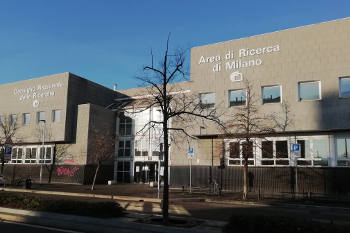
The secondary office of Institute of Polar Sciences of Milan is located at the CNR Area della Ricerca 3 Milano-Bicocca, Via Cozzi 53 - 20126 Milano. Map
How to find us
- by train: Greco-Pirelli Station
- by car: From the Turin-Venice highway (A4), take the "Milano - viale Zara" exit, head towards the center of Milan, then go to viale Sarca, the first street parallel to the one you are traveling on the left side. Continuing along Viale Sarca in the same direction of travel you will meet the University of Milano-Bicocca on your left, after about a kilometer.
- by plane: Linate Airport, take the bus n. 73 (direction S. Babila M1) and get off at Precotto. Then take the tram n.7 and get off at Greco Pirelli. Malpensa Airport: take the Malpensa Express train. From Cadorna station take the M1 line (direction: Sesto 1° Maggio). Then take the tram n. 7 and get off at Greco Pirelli. Orio al Serio airport: take the bus toward Stazione Centrale, then take the bus n. 87.
Securo Andrea
 Geosciences graduate from the University of Trieste, currently pursuing a PhD in Polar Sciences at Ca' Foscari University as part of the Local Glaciers Sisimiut (LoGS) project.
His research interests revolve around the cryosphere in polar and alpine environments, employing a combination of remote sensing, geomorphological and glaciological techniques.
Tesi di Laurea / Degree Theses
SESS report 2022: Call is open
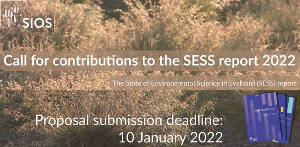 A new call SIOS to contribute to the state of environmental science in Svalbard (SESS) has been issued. SIOS seeks proposals for new and update chapters that highlight and contribute to the development of the Earth Observing System in and around Svalbard. Call was opened on the 1st of December and will close on 10th January 2022.
SIOS ha lanciato un nuovo bando per contribuire al SESS report. In particolare SIOS è alla ricera di proposte per nuovi capitoli e aggiornamenti dei capitoli precedenti che possano contribuire allo sviluppo del Sistema di osservazione della Terra nelle e intorno alle Svalbard. Il bando è stato aperto il 1 dicembre e si chiuderà il 14 gennaio 2022.
Sciacca Virginia
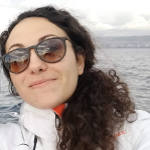
Researcher at the National Research Council – Institute of Polar Sciences (CNR-ISP), Messina branch (Italy), since December 2021. She obtained her MSc in Marine Biology and Coastal Ecology (2012) and her PhD in Environmental Sciences (2016) from the University of Messina. Her research focuses on marine bioacoustics, with particular emphasis on the ecology, distribution and impact of anthropogenic noise on marine mammals. She also develops and applies methodologies and tools for the automated analysis of large acoustic datasets, integrating interdisciplinary approaches and advanced technologies for marine environmental monitoring. Throughout her career, she has been involved in national and international research projects, collaborating with major research infrastructures and deep-sea observatories (EMSO, KM3NeT, INFN-LNS). She conducted research at the Ocean Acoustics Lab of the Alfred Wegener Institute (AWI, Germany), contributing to the development of international collaborations in marine bioacoustics and polar science. From 2023 to 2026, she has served as Principal Investigator of the PRIN PNRR project KNOWhale and as Unit leader in the PRIN 2022 project DIVES, both funded under the Next Generation EU programme (Mission 4 “Education and Research” – Component C2 Investment 1.1). She is also CNR Principal Investigator for the Horizon Europe project LOWNOISER. She participates in coordination activities in international contexts, in particular as Italian national representative in the PAME Working Group (“Protection of the Arctic Marine Environment”) of the Arctic Council. She is author of publications in international peer-reviewed (ISI-indexed) journals, as well as contributions to conference proceedings, books and technical reports, as documented in her ORCID profile. Her work has been presented across a wide range of national and international conferences. She is a founding and board member of the non-profit organization eConscience – Art of Soundscape, dedicated to scientific research and public outreach.
 https://orcid.org/0000-0002-7711-1249 Scopus - Author ID: 56427768600
Rosso Beatrice
 PhD in Environmental Sciences from the Ca’ Foscari University of Venice, with a thesis on the assessment of Small Microplastics (<100 µm) fluxes and other pollutants from the atmospheric compartment to highways stormwaters run-off. Research fellow (2019-2020) at Ca’ Foscari University with a research project in the development and analysis of microplastics (<100 µm) and plastic additives via MicroFTIR and PyrGC/MS in different environmental matrices, such as water, sediment, biota, snow, aerosol and ice cores also from Svalbard Islands. Winner of an Arctic Field Grant 2020 on the quantification and identification of small microplastics, additives, and plasticizers in snow and aerosol from Ny-Ålesund, Svalbard Island.
Current position: Research Fellow at CNR-ISP on the microplastics and plastic additives analysis and environmental impact assessment in different polar matrices.
Progetto CryoKarst - Criosfera sotterranea nelle aree carsiche
 2 Dicembre 2021
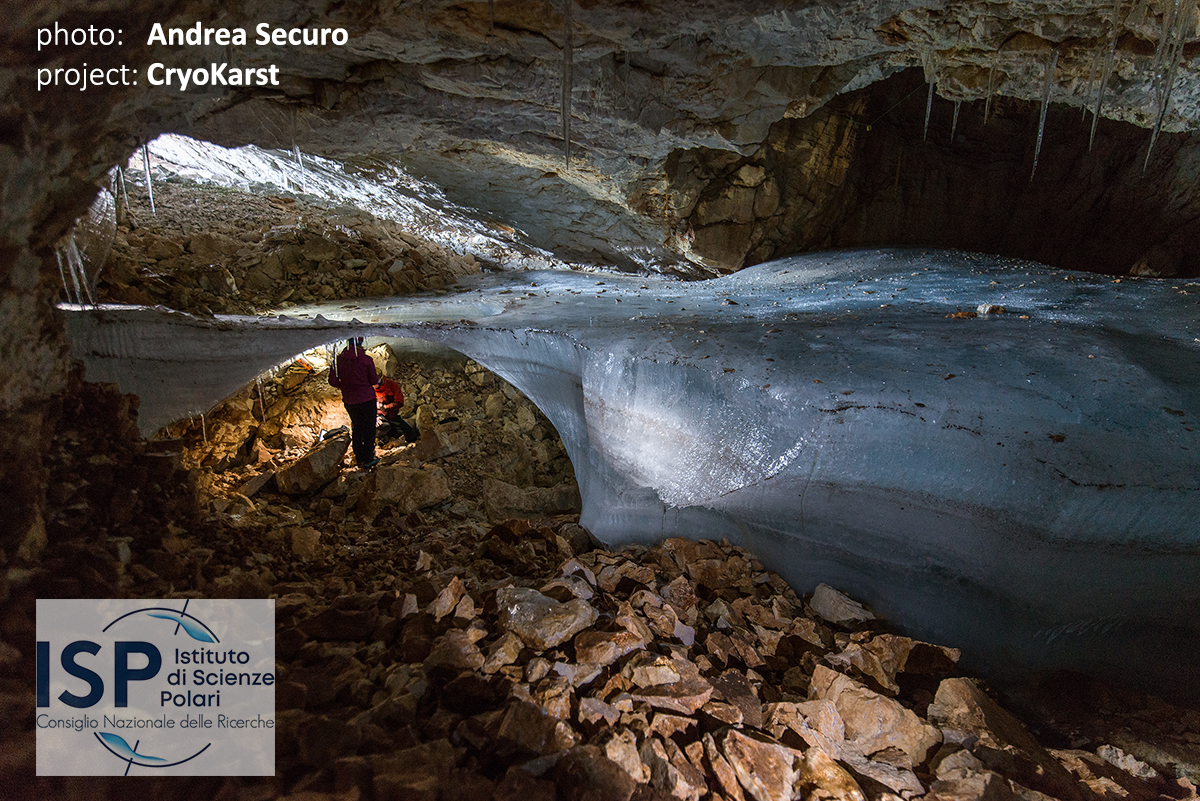
Le attività di ricerca sulla criosfera sotterranea nelle aree carsiche di alta quota del Friuli Venezia Giulia saranno realizzate all'interno del progetto CryoKarst (Cryosphere in the Karstic environments of Friuli Venezia Giulia) grazie ad un accordo operativo stipulato tra l'Istituto di Scienze Polari (CNR-ISP) ed il Servizio Geologico della Regione Autonoma Friuli Venezia Giulia.
Il progetto ha tra gli obiettivi primari lo sviluppo di tecniche di rilevamento in ambienti glaciali ipogei e l'implementazione del catasto speleologico regionale attraverso la revisione del Catasto stesso, la stesura di un protocollo di rilevamento, l'organizzazione di eventi formativi, il monitoraggio e studio delle interazioni clima-criosfera negli ambienti glaciali sotterranei dell'area pilota del Monte Canin (clima, paleoclima, geomorfologia ed evoluzione del permafrost), lo sviluppo e la sperimentazione di tecniche SfM.MVS per l'esecuzione di rilievi tridimensionali e l'evoluzione dei depositi nel corso del tempo.
Collaborano al Piano delle Attività anche la Società Meteorologica Alpino-Adriatica ed il Parco Naturale delle Prealpi Giulie, oltre ai gruppi speleologici del Friuli Venezia Giulia. I responsabili scientifici del progetto sono Renato R. Colucci (CNR-ISP) e Paolo Manca con Michele Potleca per il Servizio Geologico della Regione Autonoma Friuli Venezia Giulia.
Scalabrin Elisa
 Researcher at Institute of Polar Sciences-CNR (CNR-ISP), Venice, Italy. Master graduated in Environmental Sciences in 2011 at Ca’ Foscari University, she obtained the PhD in Environmental Sciences in 2015 at the same University. She was Research fellow at the Department of Environmental Science, Informatics and Statistics of Ca’ Foscari University from 2015 to 2021. Among her main research interests are untargeted metabolomics, applied to the study of plants and environmental matrices, emerging contaminant analysis, the development of analytical methods for the determination of organic compounds with HPLC-HRMS techniques. She participated to national research projects (PNRA, PRIN); she is author of 10 publications on international journals with more than 190 citations (h index=7).
Scopus - Author ID: 55480654200 https://orcid.org/0000-0001-7092-5963 ResearcherID: K-6496-2016
Progetto CryoKarst - Criosfera sotterranea nelle aree carsiche
2 Dicembre 2021
Le attività di ricerca sulla criosfera sotterranea nelle aree carsiche di alta quota del Friuli Venezia Giulia saranno realizzate all'interno del progetto CryoKarst (Cryosphere in the Karstic environments of Friuli Venezia Giulia) grazie ad un accordo operativo stipulato tra l'Istituto di Scienze Polari (CNR-ISP) ed il Servizio Geologico della Regione Autonoma Friuli Venezia Giulia.
Il progetto ha tra gli obiettivi primari lo sviluppo di tecniche di rilevamento in ambienti glaciali ipogei e l'implementazione del catasto speleologico regionale attraverso la revisione del Catasto stesso, la stesura di un protocollo di rilevamento, l'organizzazione di eventi formativi, il monitoraggio e studio delle interazioni clima-criosfera negli ambienti glaciali sotterranei dell'area pilota del Monte Canin (clima, paleoclima, geomorfologia ed evoluzione del permafrost), lo sviluppo e la sperimentazione di tecniche SfM.MVS per l'esecuzione di rilievi tridimensionali e l'evoluzione dei depositi nel corso del tempo.
Collaborano al Piano delle Attività anche la Società Meteorologica Alpino-Adriatica ed il Parco Naturale delle Prealpi Giulie, oltre ai gruppi speleologici del Friuli Venezia Giulia. I responsabili scientifici del progetto sono Renato R. Colucci (CNR-ISP) e Paolo Manca con Michele Potleca per il Servizio Geologico della Regione Autonoma Friuli Venezia Giulia.
CNR-ISP
National Research Council
Institute of Polar Sciences
c/o Scientific Campus - Ca' Foscari University Venice - Via Torino, 155 - 30172 VENEZIA MESTRE (VE)
Phone: +39 041 2348547 - E-mail: protocollo.isp AT pec.cnr.it
Fax: +39 041 2348 549 - Codice Fiscale: 80054330586 - P.I.:02118311006
Unless otherwise indicated, the content of this site is licensed : Attribution Non Commercial Share Alike 4.0 International (CC BY-NC-SA 4.0)
Privacy policy e Cookie policy - Transparent administration (CNR)